

AIS Basics | Class A vs Class B AIS | IMO Requirements
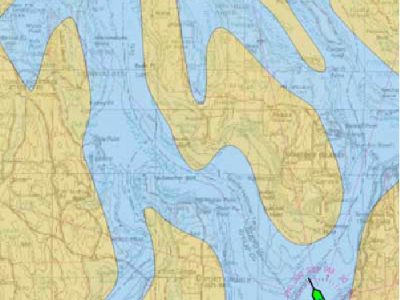 Without AIS
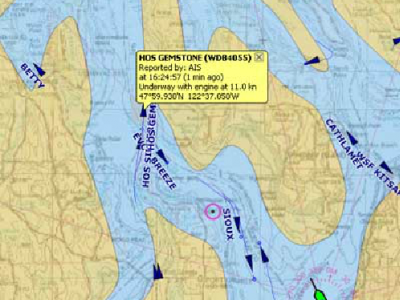
Screen shots captured with Coastal Explorer by RosePoint Navigation.
Automatic Identification System Basics
An AIS (Automatic Identification System) is a tool for identifying and monitoring maritime traffic by sending and receiving vessel information on dedicated VHF radio frequencies. Displaying AIS information on a laptop computer, chart plotter, or other MFD (Multi-Function Display) enhances situational awareness and enables mariners to make informed decisions.
AIS Broadcasts:
|
Some applications for AIS include:
|
How AIS Works: Click image for a larger view.
(Automatic Identification System)
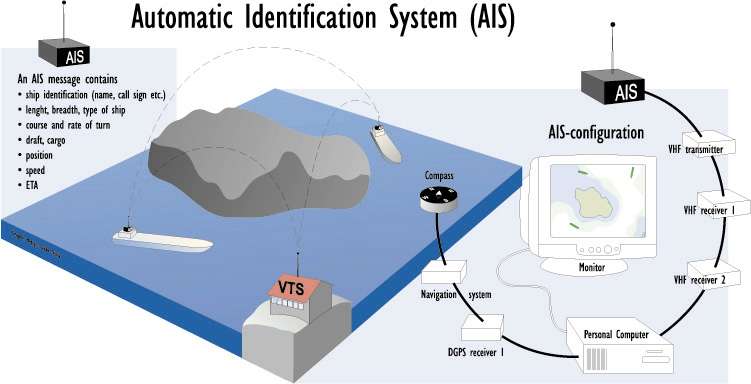
One application for shore-side AIS: Stewardship
Visit our About MMSI page For more information about MMSI numbers. Click here to register your MMSI number with Shine Micro for inclusion in the combined MMSIspace database, which works like a directory for MMSI numbers and includes live, interactive mapping features.
The United States Coast Guard describes an Automatic Identification System as follows:
Picture a shipboard radar display, with overlaid electronic chart data, that includes a mark for every significant ship within radio range, each as desired with a velocity vector (indicating speed and heading). Each ship “mark” could reflect the actual size of the ship, with position to GPS or differential GPS accuracy. By “clicking” on a ship mark, you could learn the ship name, course and speed, classification, call sign, registration number, MMSI, and other information.
Maneuvering information, closest point of approach (CPA), time to closest point of approach (TCPA) and other navigation information, more accurate and more timely than information available from an automatic radar plotting aid, could also be available. Display information previously available only to modern Vessel Traffic Service operations centers could now be available to every AIS-equipped ship.
With this information, you could call any ship over VHF radiotelephone by name, rather than by “ship off my port bow” or some other imprecise means. Or you could dial it up directly using GMDSS equipment. Or you could send to the ship, or receive from it, short safety-related email messages.The AIS is a shipboard broadcast system that acts like a transponder, operating in the VHF maritime band, that is capable of handling well over 4,500 reports per minute and updates as often as every two seconds. It uses Self-Organizing Time Division Multiple Access (SOTDMA) technology to meet this high broadcast rate and ensure reliable ship-to-ship operation.
Class A AIS vs. Class B AIS
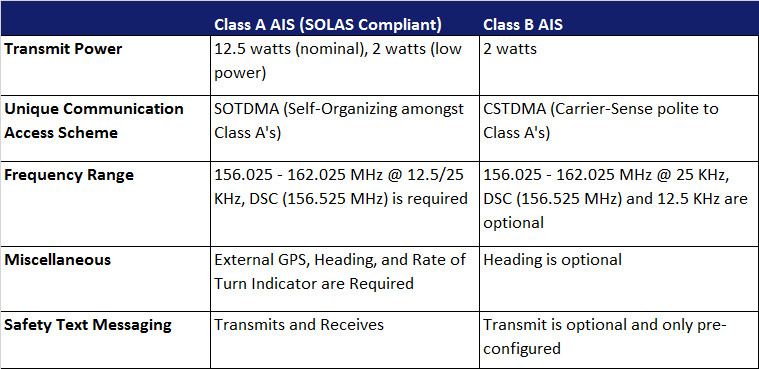
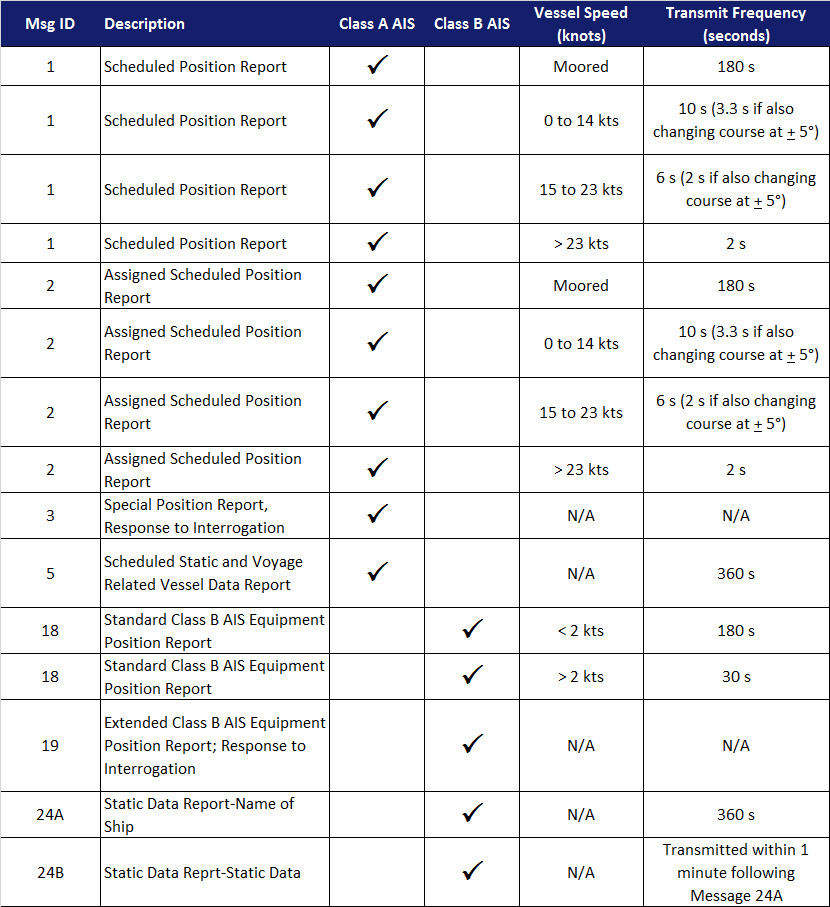
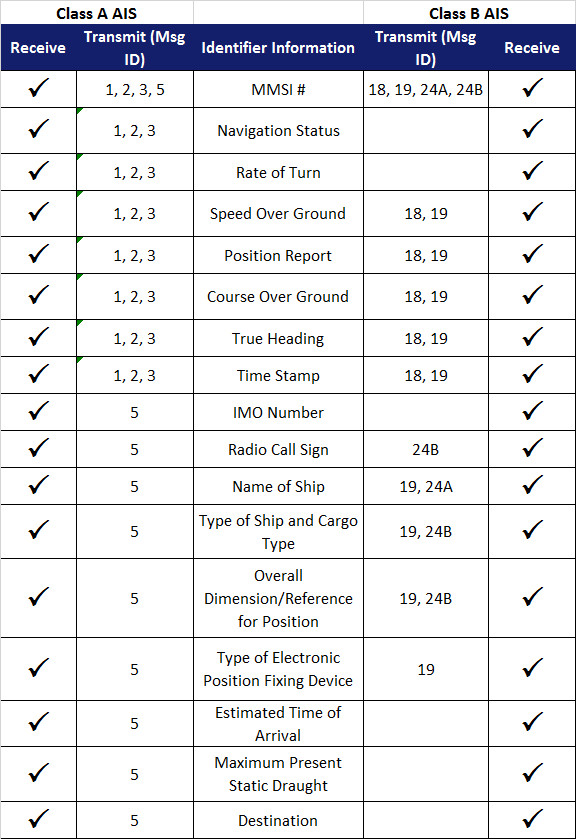
Class A AIS transponders (SOLAS Compliant) operate using Self-Organizing TDMA (SOTDMA) broadcast mode and transmit at a power level of 12.5 watts. Dynamic information is transmitted every 2 to 10 seconds while underway and every 3 minutes while at anchor. Static and voyage related information, such as the vessel’s name and cargo, are transmitted every 6 minutes. Class A AIS transponders are required to have a DSC (156.525 MHz) receiver, external GPS, heading, and rate of turn indicator, and can also transmit and receive safety-related text messages.
Class B AIS transponders operate using Carrier-Sense TDMA (CSTDMA) broadcast mode and transmit at a power level of 2 watts. Dynamic data is transmitted every 30 to 180 seconds, while static data is transmitted every 6 minutes. A DSC receiver and heading are optional. Transmitting safety-related text messages is also optional, and only available if pre-configured into the Class B AIS transponder.
Class A AIS and Class B AIS Characteristics
Commonly Used AIS Messages
IMO Requirements
The standards and regulations of AIS are established by the International Maritime Organization. The majority of maritime traffic has been required to operate AIS equipment since July of 2004, as stated below:
Modifications to Chapter V (Safety of Navigation) contain a new timetable for the fitting of Automatic Information Systems (AIS). Ships, other than passenger ships and tankers, of 300 gross tonnage and upwards but less than 50,000 gross tonnage, will be required to fit AIS not later than the first safety equipment survey after 1 July 2004 or by 31 December 2004, whichever occurs earlier. Ships fitted with AIS shall maintain AIS in operation at all times except where international agreements, rules or standards provide for the protection of navigational information.
Furthermore, Title 33 of the United States Code of Federal Regulations states that:
Self-propelled vessels of 65 feet or more in length, other than passenger and fishing vessels, in commercial service and on an international voyage, not later than December 31, 2004.
The US Congress is considering requiring ships subject to the Bridge-to-Bridge Radiotelephone Act, small passenger vessels, and commercial towing vessels while towing, to also carry AIS (Automatic Identification System) equipment.
Additional details about AIS carriage requirements and questions frequently asked may be found on the US Coast Guard website.